
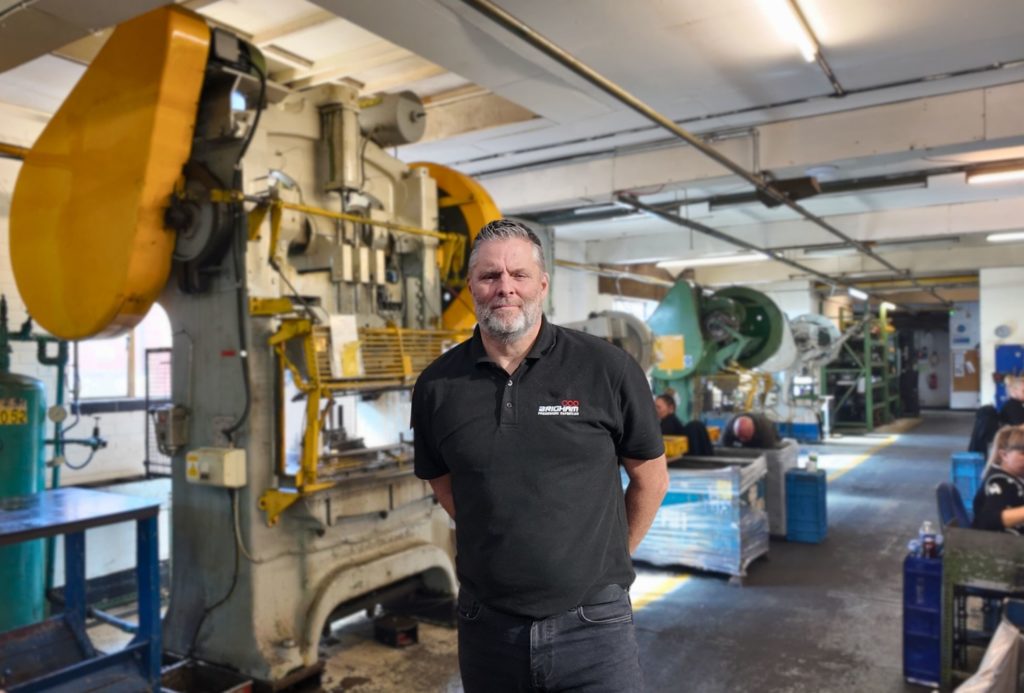
As the UK accelerates defence spending and rethinks industrial resilience, attention is increasingly shifting down the supply chain. Beyond prime contractors and Tier 1 integrators, manufacturers once viewed as “automotive specialists” are finding themselves in demand for defence programmes that value repeatability, traceability and long-term reliability over novelty.
Midlands-based precision pressings manufacturer HT Brigham is one such business seeing renewed interest from defence and security customers, as skills honed in high-volume automotive production prove increasingly relevant to regulated, mission-critical environments.
For Managing Director Allan Murray, the crossover is less surprising than it might appear.
“Automotive has always been a demanding sector,” he says. “You’re producing components in very high volumes, to tight tolerances, with zero margin for error. Defence programmes may look different on the surface, but the fundamentals are the same: reliability, consistency and absolute confidence in the supply chain.”
Founded in 1947, HT Brigham specialises in complex progression presswork, multi-stage transfer pressings and assemblies, producing components in volumes ranging from tens of thousands to many millions. Its parts are rarely visible to end users, but they are integral to systems where failure is not an option.
“In many cases, our customers design their production lines around our components,” Murray explains. “If our parts don’t perform exactly as intended, everything downstream is affected. That sense of responsibility drives how we invest, how we tool up and how we manage quality.”
That approach is resonating as defence manufacturers face mounting pressure to demonstrate supply-chain resilience amid geopolitical uncertainty, export controls and heightened regulatory scrutiny. While defence volumes are often lower than automotive, the expectations around documentation, process control and repeatability are arguably higher.
“What defence customers are increasingly looking for is industrial maturity,” Murray says. “They want suppliers who are used to operating under pressure, who understand traceability and who can demonstrate that what they make today will be exactly the same in five or ten years’ time.”
The shift comes as UK defence spending continues to rise and NATO commitments drive demand for domestically anchored manufacturing capability. For Tier 2 suppliers, this has created opportunities — but also raised the bar.
“There’s no shortcut into defence,” Murray notes. “You can’t just rebadge yourself. You have to be prepared for audits, for rigorous approval processes, and for long-term programmes where consistency matters more than speed.”
HT Brigham’s background in automotive, where OEMs and Tier 1 suppliers demand near-perfect delivery performance, has shaped a culture well suited to that environment. Investment decisions are typically tied directly to customer programmes, with a focus on tooling robustness, press capability and process control rather than speculative expansion.
“We’re not chasing volume for its own sake,” Murray says. “Our philosophy is to support customers who need parts they don’t have to worry about. If we’re doing our job properly, our components are invisible — but indispensable.”
Industry observers note that this kind of capability is becoming increasingly valuable as defence primes look to de-risk supply chains and reduce reliance on overseas suppliers. The result is a reappraisal of UK-based pressings and forming specialists that can demonstrate both scale and discipline.
For Murray, the convergence of automotive and defence requirements reflects a broader shift in manufacturing priorities.
“There’s been a lot of focus on innovation and disruption in recent years,” he says. “Those things matter, but in the current climate, reliability is what keeps production lines running and programmes on track. That’s where businesses like ours come into their own.”
As defence and security programmes gather momentum, suppliers able to translate automotive-grade precision into regulated environments are likely to find themselves firmly back on the radar — not as niche subcontractors, but as critical partners in the UK’s industrial base.
Midlands-based precision pressings manufacturer HT Brigham is one such business seeing renewed interest from defence and security customers, as skills honed in high-volume automotive production prove increasingly relevant to regulated, mission-critical environments.
For Managing Director Allan Murray, the crossover is less surprising than it might appear.
“Automotive has always been a demanding sector,” he says. “You’re producing components in very high volumes, to tight tolerances, with zero margin for error. Defence programmes may look different on the surface, but the fundamentals are the same: reliability, consistency and absolute confidence in the supply chain.”
Founded in 1947, HT Brigham specialises in complex progression presswork, multi-stage transfer pressings and assemblies, producing components in volumes ranging from tens of thousands to many millions. Its parts are rarely visible to end users, but they are integral to systems where failure is not an option.
“In many cases, our customers design their production lines around our components,” Murray explains. “If our parts don’t perform exactly as intended, everything downstream is affected. That sense of responsibility drives how we invest, how we tool up and how we manage quality.”
That approach is resonating as defence manufacturers face mounting pressure to demonstrate supply-chain resilience amid geopolitical uncertainty, export controls and heightened regulatory scrutiny. While defence volumes are often lower than automotive, the expectations around documentation, process control and repeatability are arguably higher.
“What defence customers are increasingly looking for is industrial maturity,” Murray says. “They want suppliers who are used to operating under pressure, who understand traceability and who can demonstrate that what they make today will be exactly the same in five or ten years’ time.”
The shift comes as UK defence spending continues to rise and NATO commitments drive demand for domestically anchored manufacturing capability. For Tier 2 suppliers, this has created opportunities — but also raised the bar.
“There’s no shortcut into defence,” Murray notes. “You can’t just rebadge yourself. You have to be prepared for audits, for rigorous approval processes, and for long-term programmes where consistency matters more than speed.”
HT Brigham’s background in automotive, where OEMs and Tier 1 suppliers demand near-perfect delivery performance, has shaped a culture well suited to that environment. Investment decisions are typically tied directly to customer programmes, with a focus on tooling robustness, press capability and process control rather than speculative expansion.
“We’re not chasing volume for its own sake,” Murray says. “Our philosophy is to support customers who need parts they don’t have to worry about. If we’re doing our job properly, our components are invisible — but indispensable.”
Industry observers note that this kind of capability is becoming increasingly valuable as defence primes look to de-risk supply chains and reduce reliance on overseas suppliers. The result is a reappraisal of UK-based pressings and forming specialists that can demonstrate both scale and discipline.
For Murray, the convergence of automotive and defence requirements reflects a broader shift in manufacturing priorities.
“There’s been a lot of focus on innovation and disruption in recent years,” he says. “Those things matter, but in the current climate, reliability is what keeps production lines running and programmes on track. That’s where businesses like ours come into their own.”
As defence and security programmes gather momentum, suppliers able to translate automotive-grade precision into regulated environments are likely to find themselves firmly back on the radar — not as niche subcontractors, but as critical partners in the UK’s industrial base.