In today’s automotive sector, supply chain resilience is increasingly as important as engineering capability. When a supplier falters, the consequences can ripple quickly through production schedules, placing intense pressure on OEMs and Tier 1 partners to restore stability without interrupting vehicle output.
For manufacturers facing that challenge, the ability to transfer tooling and restore predictable supply quickly has become a critical capability.
A recent drivetrain and engine presswork recovery project delivered by HT Brigham Pressings highlights how the Midlands manufacturer is positioning itself as a reliable partner when supply chains require rapid stabilisation.
The project began when a major Tier 1 automotive supplier — responsible for shipping millions of powertrain assemblies annually — faced escalating disruption from quality and delivery issues at an incumbent presswork supplier.
Thirty-two stainless steel drivetrain and engine components, produced across multiple tooling sets, were central to the programme. Quality spillages had driven scrap levels to 300 parts per million (PPM), triggering missed deliveries and forcing the customer into costly mitigation measures, including emergency logistics and the risk of line stoppages.
The solution required more than simply taking on additional work. It demanded a structured engineering intervention capable of restoring process stability and quality assurance while maintaining the tight delivery windows required by engine assembly operations.
Doug Allen, CEO of HT Brigham Pressings, explains the situation:
“When a programme reaches that point, the priority is not just producing parts again — it’s restoring confidence in the process. Customers need to know that the tooling, the presses and the quality controls are all working together in a stable, predictable way.”
A Four-Week Recovery
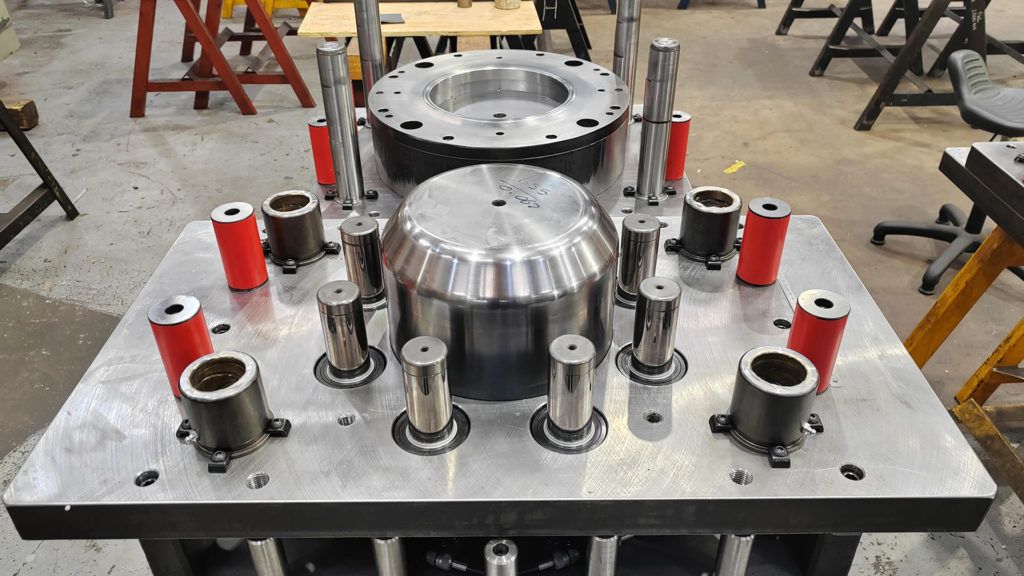
HT Brigham Pressings accepted the transfer of 32 existing drivetrain tools, undertaking a full inspection and engineering review before production began.
Each die was stripped down and laser-measured to assess wear and alignment. Damaged or degraded surfaces were refaced or replaced, ensuring the tools could operate within specification before entering production again.
The company also implemented a structured preventive maintenance regime integrated into its ERP systems, enabling automated scheduling of die servicing to prevent future tolerance drift.
Equally important was matching each tool to the most suitable press line.
Components were distributed across several machines, including Fagor 250-tonne, Chin Fong 400-tonne and Bruderer 60-tonne progression presses, ensuring optimal forming forces and process consistency across different part geometries and material thicknesses.
Within four weeks, the programme had progressed from tool handover to initial PPAP approval, allowing the customer to resume normal supply conditions.
Allen notes that disciplined engineering processes make such transitions possible.
“Tool transfers have to be approached methodically. You can’t simply move dies from one press shop to another and expect the same results. Our focus is always on understanding the tool condition, matching it to the right press and embedding the right process control from day one.”
Beyond restoring basic production capability, Brigham introduced additional in-process dimensional checks, supported by live capability monitoring through its quality dashboard.
Critical dimensions were tracked continuously, with process capability (Cpk) monitored in real time. This approach allowed engineers to identify and correct any process variation before it could develop into reject parts.
The results were immediate.
Scrap levels fell from 300 PPM to 80 PPM, representing a 73 per cent reduction in defects, while on-time delivery improved from 41 per cent to 100 per cent once the programme stabilised.
The customer noted that the recovery not only restored delivery confidence but also improved cost efficiency.
For Allen, the project illustrates a broader reality within the automotive sector.
As cost pressures and technological transitions reshape the industry, supply chain resilience is becoming a critical differentiator.
“Manufacturers are increasingly asking themselves a simple question: if something goes wrong in the supply chain, who has the capability and discipline to step in and stabilise it? That’s where experienced engineering businesses can really add value.”
HT Brigham Pressings has quietly built a reputation for precisely that capability — combining press capacity, toolroom expertise and structured quality systems that allow complex programmes to be transferred and stabilised without disruption.
Allen emphasises that such work is never about opportunism.
“No supplier wants to see another business struggle. But when customers face disruption, they need a dependable option. Our role is simply to provide that stability and help programmes get back on track.”
The drivetrain recovery project ultimately demonstrates a principle that many automotive procurement teams are rediscovering: predictable manufacturing processes are the foundation of supply chain confidence.
By combining disciplined tool management, press optimisation and digital quality monitoring, Brigham was able not only to restore supply but to significantly improve process performance.
In a market where reliability is increasingly valued alongside cost competitiveness, the ability to deliver that predictability may prove to be one of the company’s most valuable assets.