
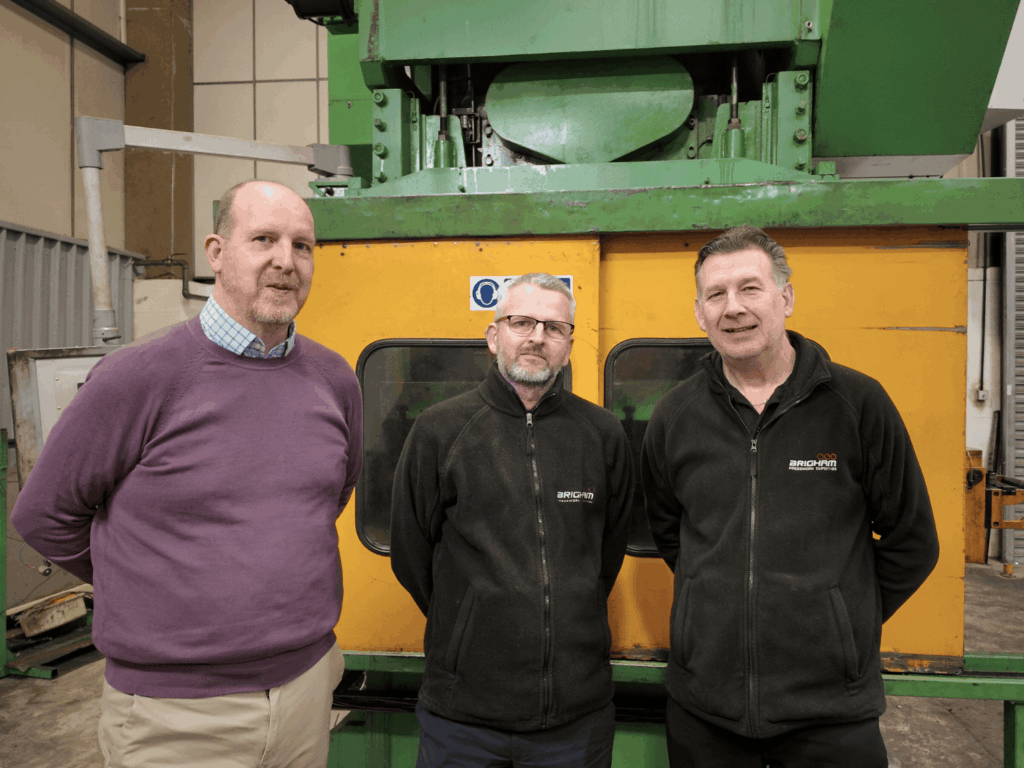
Recent commentary on the future of UK manufacturing has reignited a familiar debate: how Britain rebuilds its industrial base after decades of economic drift towards services. The argument is that if the UK wants to restore economic resilience, productivity and export strength, it must start making things again.
For manufacturers on the ground, that observation is less a theory than a daily reality.
At companies such as Brigham Pressings, the conversation about rebuilding Britain’s manufacturing capability begins with the fundamentals of modern production – precision pressings, engineered presswork, metal stampings, and the advanced tooling that makes them possible.
These processes rarely make headlines, yet they sit at the heart of nearly every industrial supply chain, from aerospace and automotive to electronics, energy and infrastructure.
The overlooked foundation of UK manufacturing
Metal pressings and stampings are among the most efficient methods of producing high-volume, high-precision components. Using progression tools and sophisticated presswork machinery, manufacturers can produce complex components at speed and scale while maintaining tight tolerances.
For sectors that depend on consistency, cost efficiency and repeatability, pressings are indispensable.
Doug Allen, CEO of Brigham Pressings, believes the current debate about Britain’s industrial future must pay greater attention to these core manufacturing capabilities.
“When people talk about rebuilding UK manufacturing, they often focus on the finished product – electric vehicles, aircraft systems or renewable energy technologies,” said Allen. “But behind every one of those industries is a network of specialist manufacturers producing precision pressings, stampings and tooling that make large-scale production possible.”
“If the UK wants to strengthen its industrial base, it needs to support the entire manufacturing ecosystem, including the companies designing progression tools, running high-volume presswork operations and producing the metal components that keep supply chains moving.”
The role of tooling and presswork expertise
One of the key strengths of British presswork manufacturers lies in their toolmaking capability.
Progression tooling – precision-engineered tooling systems that allow multiple forming operations to take place in a single press cycle – enables manufacturers to produce complex components efficiently and repeatedly.
For industries where tolerances are measured in microns, tooling expertise is as important as the presses themselves.
Allen argues that this type of engineering knowledge represents an underappreciated national asset.
“The UK still has exceptional engineering talent in areas like progression tooling and precision presswork,” he said. “These skills have been built up over decades and are incredibly difficult to replicate once they’re lost.”
“If we want to compete globally, protecting and developing these capabilities must be part of any serious industrial strategy.”
Resilient supply chains begin with domestic capability
The pandemic exposed the risks of over-reliance on global supply chains, particularly for critical manufactured components. When international logistics stalled, companies that had maintained domestic manufacturing capability proved more resilient.
For Brigham Pressings, the lesson was clear: localised supply chains matter.
Presswork manufacturers often sit several tiers deep within industrial supply chains, quietly producing the metal components used in assemblies around the world. When these suppliers disappear, entire production systems become more fragile.
“Reshoring and supply chain resilience are no longer theoretical discussions,” Allen explained. “Many OEMs are actively looking to bring production closer to home.”
“Having strong UK pressings and stampings manufacturers means critical components can be produced domestically, reducing lead times and giving manufacturers greater control over quality and supply.”
Investment, productivity and the manufacturing multiplier
Manufacturing remains one of the most productive sectors of the economy. Investment in equipment, tooling and automation can significantly increase output while creating highly skilled jobs.
In presswork manufacturing, investment often centres on high-tonnage presses, advanced tooling systems, and automated inspection technologies that ensure consistent quality across large production runs.
Allen believes this is where UK manufacturing can still compete effectively on the global stage.
“Presswork is a sector where productivity improvements can deliver real economic gains,” he said. “Modern presses combined with well-designed progression tools allow manufacturers to produce millions of high-quality components with remarkable efficiency.”
“That productivity feeds directly into competitive supply chains for industries like aerospace, automotive and energy.”
From industrial decline to industrial opportunity
While Britain may never return to the scale of manufacturing dominance it once enjoyed, there is growing recognition that a stronger industrial base is essential to long-term economic stability.
For companies already operating in advanced manufacturing, the challenge is less about rediscovering industry and more about supporting the capabilities that already exist.
Pressings, stampings and precision presswork may not command the political spotlight, but they remain a vital part of the country’s manufacturing infrastructure.
As Allen concludes:
“The UK still has the skills, the engineering expertise and the industrial heritage to remain a serious manufacturing nation.”
“But if we want to rebuild that strength, we need to start with the companies that are already making things — from precision metal pressings to progression tooling — and ensure they have the support to grow.”
In the debate about Britain’s manufacturing future, the answer may be less about rediscovering industry and more about recognising the value of the one that has quietly endured.