
UK manufacturers are being urged to rethink outsourcing as a long-term strategic lever for growth, as economic volatility, supply chain disruption and rising operational costs continue to reshape the industrial landscape.
According to HT Brigham Pressings, the shift presents a significant opportunity for OEMs to partner with agile, capability-driven suppliers that offer far more than additional capacity — delivering integrated expertise in project management, presswork, tooling and complex assemblies under robust quality frameworks such as AS9100.
Doug Allen, CEO of HT Brigham Pressings, believes the conversation around outsourcing is undergoing a fundamental reset.
“For many manufacturers, outsourcing still starts as a reactive decision — a way to relieve pressure when capacity is stretched,” he said. “But the real value emerges when it becomes strategic. That’s when it drives resilience, not just short-term relief.”
Allen’s comments follow wider industry sentiment that manufacturers must move beyond unit cost comparisons and instead evaluate outsourcing partners on their ability to reduce risk, improve delivery performance and support long-term scalability.
In high-value sectors such as aerospace, defence and advanced engineering, this shift is particularly pronounced. OEMs are increasingly seeking partners that can take ownership of entire work packages — from progression tooling design through to precision pressings and fully assembled, quality-assured components.
“The most effective outsourcing relationships are built around capability, not cost,” Allen explained. “If you’re only benchmarking piece price, you’re missing the bigger picture. The real cost lies in delays, inconsistency and the inability to scale when demand changes.”
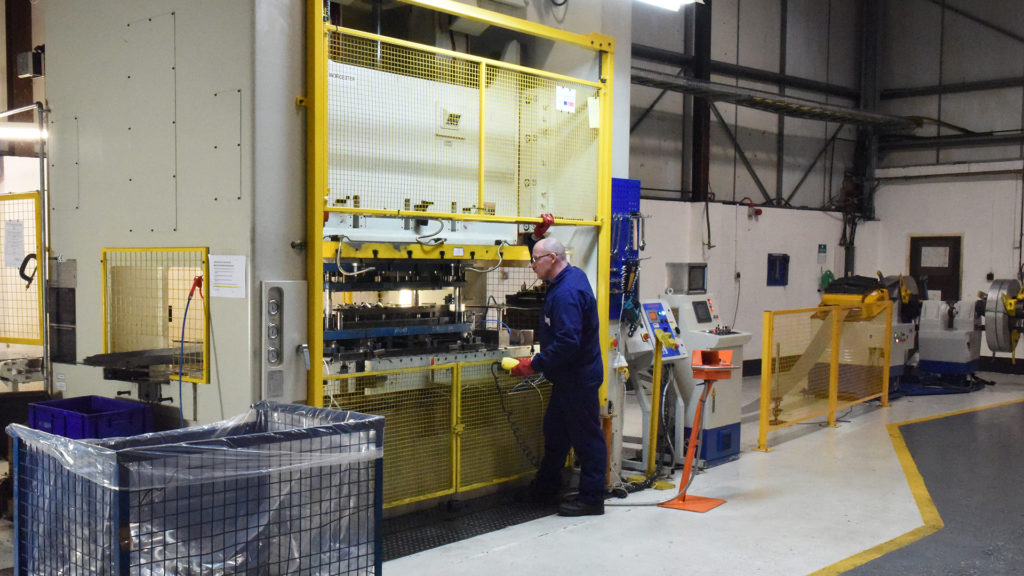
HT Brigham’s investment in advanced presswork, tooling expertise and structured project management processes reflects this evolving demand. By integrating design-for-manufacture principles early in the production cycle, the company works closely with customers to optimise component performance, reduce waste and improve repeatability.
Crucially, quality assurance has become a defining factor in outsourcing decisions. Accreditations such as AS9100 are no longer optional for suppliers operating in regulated industries, but a baseline requirement for participation in global supply chains.
“Quality approvals like AS9100 are essential because they provide confidence,” said Allen. “But beyond compliance, it’s about having the systems, documentation and discipline to support complex programmes over time. That’s what enables true partnership.”
The ability to manage volatility is emerging as one of the most compelling drivers behind strategic outsourcing. Rather than maintaining fixed overheads and underutilised capacity, manufacturers can adopt more flexible operating models by leveraging specialist partners.
This approach is enabling businesses to scale production up or down without destabilising cost structures — a critical advantage in an environment characterised by fluctuating demand and ongoing geopolitical uncertainty.
“Agility is now a competitive advantage,” Allen added. “Manufacturers that build ecosystems of trusted partners will outperform those trying to do everything in-house. It’s about focusing on what you do best and aligning with partners who complement that.”
As outsourcing matures from a tactical solution into a core element of industrial strategy, HT Brigham argues that manufacturers must also reassess how they define their own core competencies.
For many, this means retaining high-value intellectual property, customer relationships and final system integration, while partnering on areas such as pressings, tooling and sub-assembly manufacture where specialist expertise can deliver superior outcomes.
“The question isn’t ‘what can we outsource?’,” Allen concluded. “It’s ‘what should we own, and where can a partner create more value than we can alone?’ That mindset shift is what will define the next generation of UK manufacturing.”
With demand growing for resilient, high-quality supply chains, the role of capable, accredited partners is set to become increasingly central — positioning firms like HT Brigham Pressings at the heart of a more collaborative and adaptive manufacturing future.