
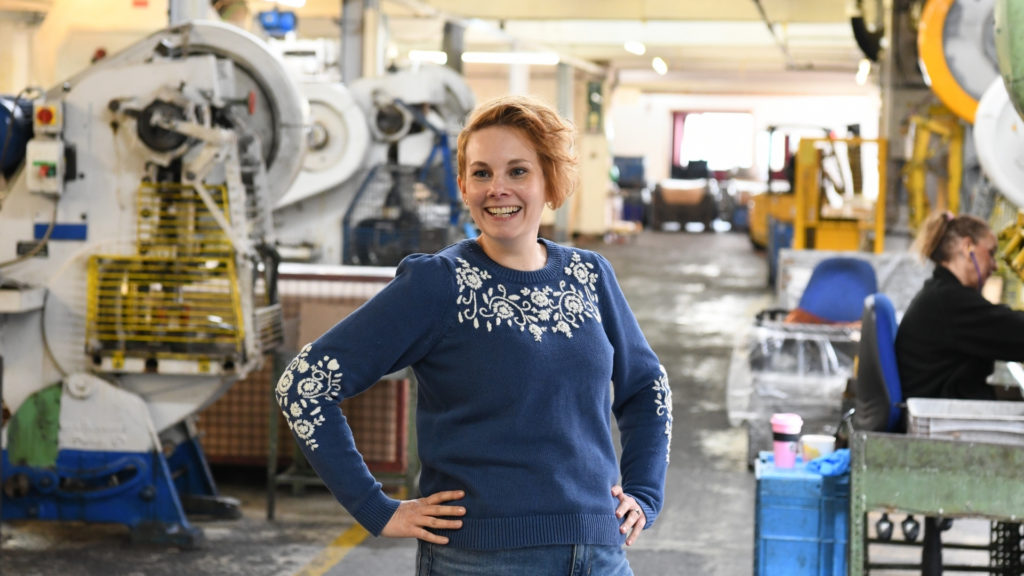
When Vertical Aerospace’s VX4 took to the skies at Farnborough International Airshow, the historic flight carried particular significance for HT Brigham Pressings Compliance Director Anna Lavender Moore.
For thousands of visitors gathered at Farnborough, the sight of an electric vertical take-off and landing aircraft performing a public transition flight offered a glimpse of aviation’s future.
For Moore, it also represented the visible culmination of years of engineering, quality, compliance and organisational development taking place behind the scenes of one of Britain’s most ambitious new aerospace programmes.
Before joining HT Brigham Pressings, Moore worked with Vertical Aerospace, contributing to the quality management and training systems supporting the development of its electric Vertical Take-Off and Landing (eVTOL) aircraft.
Her work formed part of Vertical’s multi-billion-pound New Product Introduction programme, giving her direct experience of the disciplines required as a new aircraft technology progresses through development towards certification and eventual industrialisation.
Watching the VX4 become the first eVTOL aircraft to perform publicly at Farnborough therefore carried a special resonance.
“Seeing the aircraft flying at Farnborough was an incredibly significant moment because I understand something of the scale of work, expertise and commitment that sits behind what everyone saw in the sky,” said Moore.
“An aircraft programme brings together extraordinary engineering with quality, compliance, training, process development and thousands of individual activities that all contribute towards the same objective. To see that progress demonstrated on the global stage at Farnborough was a very proud moment.”
Moore joined HT Brigham as Compliance Director following a career spanning advanced aerospace and manufacturing environments.
Her experience with Vertical included supporting the design, implementation and maintenance of quality and training systems around the company’s eVTOL development programme.
That background now brings valuable aerospace knowledge into HT Brigham as the Coleshill-based manufacturer continues developing its presence within highly regulated sectors.
According to Moore, one of the most important lessons from advanced aircraft development is the extent to which successful innovation depends upon the entire organisation and supply chain operating within a strong quality culture.
“People naturally focus on the aircraft, the propulsion technology and the flight characteristics because they are the most visible parts of the programme,” she explained.
“My experience gave me an appreciation of everything that surrounds that engineering. Quality systems, competency, training, documentation, traceability, process control and continuous improvement all contribute to creating confidence in the product and the organisation producing it.”
Those principles now form an important part of Moore’s role at HT Brigham Pressings.
HT Brigham has built its reputation around precision metal pressings, stampings, tooling and high-volume presswork, supplying components into technically demanding manufacturing environments.
Its AS9100 aerospace quality accreditation provides a framework for the process control, risk management, traceability and continuous improvement expected by aerospace customers.
Moore’s appointment strengthens that capability by bringing experience gained within a new-generation aircraft programme directly into the company’s compliance leadership.
It also gives her an unusual perspective on the relationship between emerging aerospace technologies and established manufacturing expertise.
“Working within an advanced aerospace programme teaches you to think about manufacturing as a complete system,” said Moore.
“Every component forms part of something much larger. Repeatability, process capability, tooling, documentation and traceability all matter because confidence in the finished aircraft is built through confidence in every process and every part throughout the supply chain.”
For precision manufacturers such as HT Brigham, this creates an increasingly relevant opportunity.
As emerging aircraft platforms mature, their developers require supply chains capable of translating sophisticated engineering designs into repeatable production processes.
Metal pressings can provide an efficient route to producing repeatable components at increasing volumes, particularly when manufacturers combine press capacity with tooling expertise, design-for-manufacture support, project management and established aerospace quality systems.
The Farnborough demonstration placed that journey firmly in the international spotlight.
Piloted by Vertical Aerospace Chief Test Pilot Simon Davies, the VX4 completed a transition flight from vertical take-off into wingborne flight before returning for a vertical landing.
It was the first time an eVTOL aircraft had participated in a public flying display at Farnborough International Airshow.
For Moore, the significance lies in how far the technology — and the organisations supporting it — have progressed.
“Farnborough has always been a place where aerospace demonstrates what is possible,” she said. “Seeing an eVTOL performing there sends a powerful message about the maturity that advanced air mobility is beginning to achieve.”
“I have seen first-hand the level of discipline that goes into building the systems around a new aerospace programme. Every test, every procedure, every piece of training and every improvement adds another layer of maturity. Farnborough allowed the wider industry to see the result of that collective effort.”
From Prototype Thinking to Production Thinking
As eVTOL programmes advance, Moore believes attention across the supply chain will increasingly turn towards industrialisation.
Aircraft development creates one set of engineering challenges. Building aircraft repeatedly, efficiently and within a tightly controlled quality environment creates another major area of expertise.
It is here that Moore sees a natural connection between her previous aerospace experience and her work at HT Brigham.
The company combines decades of metalforming knowledge with modern presswork, progressive tooling, precision stampings and engineering support, alongside the compliance infrastructure required for aerospace manufacturing.
“One of the most exciting stages of any aerospace programme is when production thinking becomes increasingly prominent,” Moore said.
“You start considering how processes will perform repeatedly, how suppliers will demonstrate capability, how tooling will be controlled and how quality will be embedded throughout manufacture. Those are areas where experienced UK manufacturers have a great deal to contribute.”
Her role at HT Brigham is focused on ensuring those disciplines continue developing alongside the company’s manufacturing capability.
Taking Experience from One Generation of Aerospace to the Next
The connection between Moore’s former and current roles also reflects a wider opportunity for Britain’s aerospace supply chain.
Advanced air mobility is creating new aircraft architectures, propulsion systems and potential applications, while drawing heavily upon the quality and manufacturing disciplines established through generations of aerospace production.
HT Brigham represents part of that established manufacturing base.
Its expertise in precision pressings, tooling, stampings and scalable production, combined with AS9100 accreditation and Moore’s first-hand experience of advanced aerospace programme requirements, positions the company to understand what emerging aircraft manufacturers will expect from their supply chains.
“What excites me is being able to bring experience from a pioneering aerospace environment into a business with such deep manufacturing knowledge,” Moore said.
“Brigham understands how to make components repeatedly and efficiently at scale. My experience helps us continue strengthening the quality and compliance framework around that capability so that we can speak the language of aerospace customers and understand the expectations surrounding their programmes.”
For Moore, the VX4’s appearance above Farnborough therefore represented more than an historic flying display.
It provided a highly visible demonstration of an industry she has experienced from the inside — and of the opportunities emerging for manufacturers capable of supporting its next phase.
“There is something very powerful about seeing technology you have been connected with flying in front of the global aerospace community,” she concluded.
“It also makes you think about what comes next. Behind every aircraft that reaches production will be an extensive network of manufacturers, engineers and quality professionals working together.
“The UK has tremendous capability within that supply chain. Bringing my experience from Vertical Aerospace into HT Brigham and helping strengthen our readiness for the next generation of aerospace manufacturing is something I am immensely excited about.”