
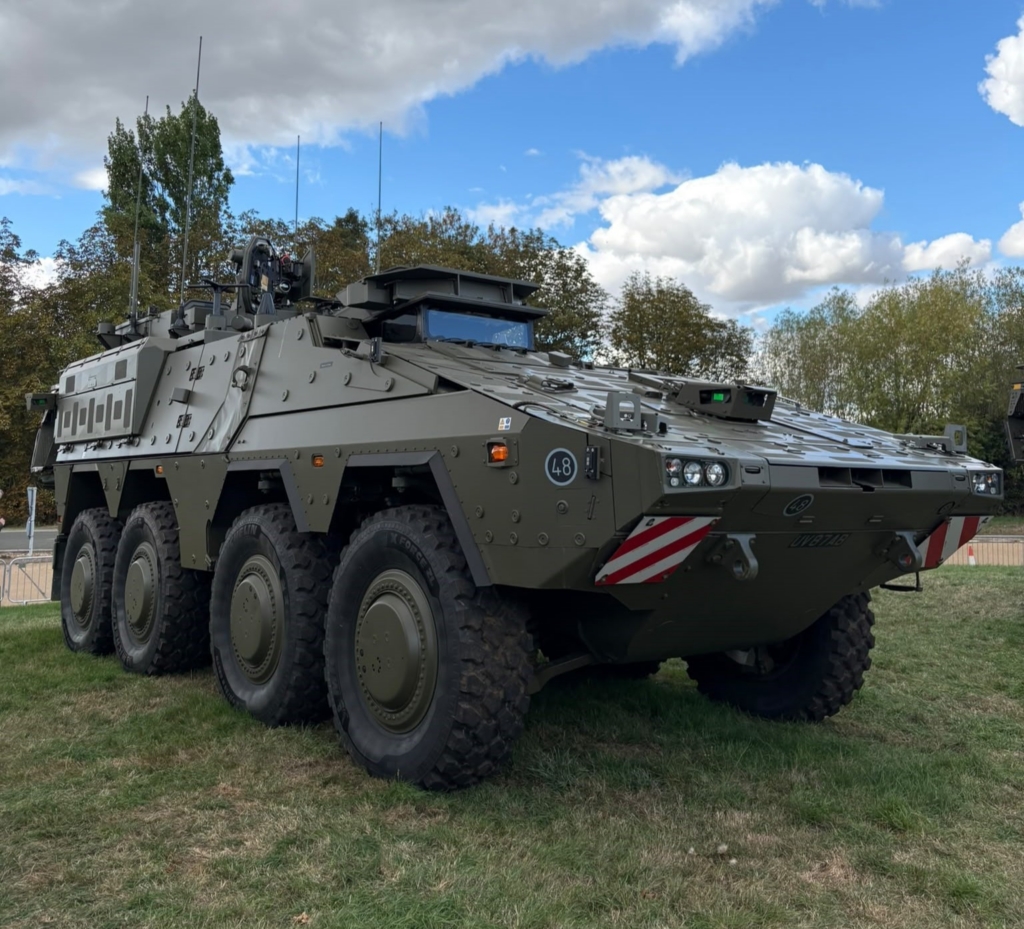
Photo: Pearson Engineering
As Britain commits to strengthening its defence industrial base, Birmingham manufacturer Brigham Pressings believes the depth of capability within the UK supply chain will become increasingly important to the delivery of the next generation of complex defence programmes.
The discussion was brought into sharp focus at DVD26 this week, where the British Army and manufacturers gathered at UTAC Millbrook to examine the future of land equipment and the industrial network required to produce it.
Among the programmes attracting attention is BOXER. Pearson Engineering, part of the UK supply chain supporting the armoured vehicle, used the event to highlight the industrial impact generated by major defence programmes. Its Armstrong Works facility in Newcastle upon Tyne now employs more than 400 people across land manufacturing activities and supports 52 apprentices.
Pearson Engineering reported more than £14 million of supplier spend during 2025, with 70% placed with UK businesses.
The figures illustrate how defence procurement can travel deep into Britain’s manufacturing economy, creating opportunities for established engineering businesses with the equipment, quality systems and production knowledge required to support long-term programmes.
That is a market Brigham Pressings CEO Doug Allen knows well. Having built a career that includes senior roles within aerospace and advanced engineering, Allen sees sovereign manufacturing capacity as a practical question of what Britain can actually produce when programmes move from design and development into sustained production.
“Sovereign capability ultimately depends on having companies with the machines, tooling, people and manufacturing knowledge to make components here in the UK,” said Allen.
“Complex platforms can contain thousands of individual parts and assemblies. Behind every prime contractor sits a substantial manufacturing network, and maintaining that network gives the UK the capacity to respond as programmes develop and production requirements change.”
Press capacity built for demanding programmes
From its Birmingham manufacturing base, Brigham Pressings provides precision metal pressings, presswork, stampings, tooling and assemblies, backed by extensive press capacity and decades of manufacturing experience.
Its production capability spans presses from smaller high-speed machines through to large-capacity presses capable of producing substantial and technically demanding components. That breadth allows Brigham to support customers from development and initial industrialisation through to repeat production.
High-speed Bruderer progression presses provide production speeds of up to 800 strokes per minute, while the company’s wider press shop supports an extensive range of component sizes, materials and production volumes. For defence OEMs and Tier One manufacturers, this breadth can become particularly valuable as programmes mature.
“Defence programmes require suppliers that understand repeatability, traceability, quality and delivery over long production cycles,” Allen continued.
“Our press capacity gives us considerable flexibility. We can look at the component, the volumes, the material and the wider programme requirements and establish a manufacturing route around what the customer is trying to achieve.”
Toolmaking keeps critical knowledge close to production
At the centre of that capability is Brigham’s in-house toolmaking expertise. Press tooling determines much of the eventual performance of a stamped component, particularly where tight tolerances, repeatability and high production volumes are involved. Brigham can take responsibility for tooling alongside presswork, giving customers access to manufacturing engineering knowledge during the industrialisation of a component.
Its engineers can work with customers on design for manufacture, progression tooling, press tooling development, maintenance and production engineering, bringing the people responsible for making the component into the programme at an early stage.
Allen believes this type of integration has a natural place within defence procurement.
“The earlier manufacturing expertise comes into a programme, the more opportunity there is to engineer a component around a robust production process,” he said.
“Our customers can bring us a drawing, an existing component or a requirement that is still being developed. We can then look at tooling, material utilisation, production rates and how that component will move into repeat manufacture.”
AS9100 brings an established quality framework
Brigham’s AS9100 quality accreditation provides another important foundation for work across highly regulated industries.
Originally developed around the aerospace sector, AS9100 places rigorous requirements around quality management, risk, traceability, configuration and process control. These disciplines align closely with the expectations found throughout sophisticated defence supply chains.
For OEM procurement teams, supplier capability therefore extends well beyond the tonnage available on the factory floor. Quality systems, programme controls, engineering expertise and the ability to maintain production performance all form part of the manufacturing proposition.
Brigham combines its production operations with dedicated project management, providing customers with a structured route from initial enquiry and tooling through to production and ongoing supply.
“Project management matters enormously when you are working within a complex supply chain,” added Allen. “There are engineering milestones, tooling programmes, approvals, production schedules and quality requirements to coordinate. Customers want visibility and confidence that somebody is taking ownership of that process.”
Building greater capability through acquisition
Brigham is also pursuing an acquisition-led growth strategy, with the business looking to expand the manufacturing capability, customer relationships and specialist expertise available within the wider group.
For Allen, acquisitions offer an opportunity to preserve valuable British manufacturing capacity while building a broader proposition for OEMs seeking capable UK supply-chain partners.
The strategy comes as government policy places greater emphasis on the industrial consequences of defence spending.
The Ministry of Defence’s 2025 Defence Industrial Strategy sets out an ambition to back UK-based businesses, develop a more resilient industrial base and transform procurement and acquisition. The MOD has subsequently set a target to increase its spending with SMEs by an additional £2.5 billion by summer 2028.
Those commitments create a substantial opportunity for established manufacturers capable of translating defence investment into components, tooling and production capacity.
From procurement policy to production
BOXER provides a visible example of how a major platform can support industrial capability far beyond the final assembly operation.
The same principle applies throughout defence manufacturing. Vehicle structures, aircraft, weapons systems and other complex equipment depend upon extensive networks of specialist businesses supplying engineered components and assemblies.
For Brigham Pressings, the opportunity is to make its Birmingham facility part of that manufacturing network, combining high-speed and heavy press capacity, in-house toolmaking, precision presswork, AS9100-accredited quality systems and experienced project management for defence customers seeking greater UK content within their programmes.
Allen added: “If Britain wants greater sovereign manufacturing capability, industry has an important role in turning that ambition into real production capacity.
“We have presses running, toolmakers and engineers working here in Birmingham, established quality systems and the experience to manage demanding manufacturing programmes. We are continuing to invest and looking at acquisitions that can strengthen that capability further.
“For defence OEMs looking at their UK supply chains, businesses such as Brigham are ready to have that conversation.”