
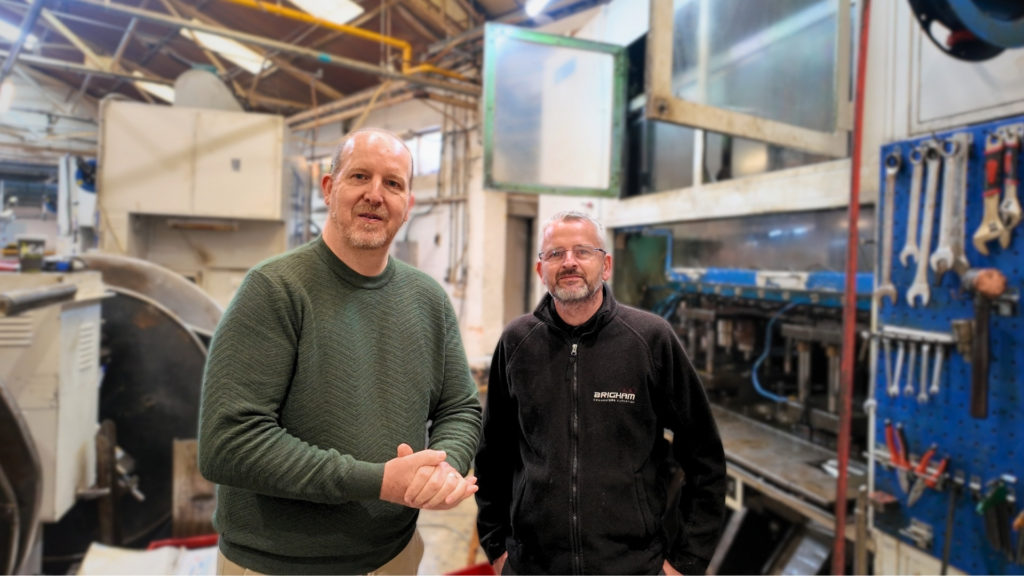
Rising costs and continued pressure across international supply chains are putting the capabilities of UK manufacturers firmly in focus, as businesses look towards closer, technically capable suppliers to support production, resilience and future growth. New research from BDO’s Mid-Market Tracker shows that 46% of UK mid-sized businesses expect supply chain pressures alongside rising fuel and energy costs to represent their biggest challenge over the next six months.
The findings also point towards a growing emphasis on domestic sourcing. Almost a third of businesses are prioritising UK-based suppliers, while a similar proportion are bringing manufacturing closer to home through on-shoring and near-shoring. For Brigham Pressings, that shift highlights the value of combining established UK manufacturing capacity with tooling expertise, quality assurance and the ability to support customers from initial component development through to repeat production.
The Coleshill-based manufacturer and global distributor produces components for the aerospace, defence and space, automotive, yellow goods and white goods markets, operating to AS9100D, IATF 16949, ISO 9001 and ISO 14001 standards.
CEO Doug Allen believes customers increasingly want manufacturing partners capable of providing both production capacity and engineering expertise.
“Supply chain resilience ultimately comes down to capability,” said Allen. “Customers want confidence that a manufacturing partner understands the component, has the equipment and tooling expertise to manufacture it consistently, and has the quality systems required to support the programme over the long term.
“That is where Brigham has a compelling proposition. We have extensive presswork capability, an integrated toolroom, established quality systems and decades of manufacturing knowledge within the business.”
At the centre of Brigham’s manufacturing operation is a diverse 60-to-400-tonne press fleet, providing progression, transfer and single-operation presswork for components across a wide range of geometries, materials and production volumes. The company’s high-speed progression capability includes three Bruderer BSTA 60-tonne presses, capable of operating at speeds of up to 800 strokes per minute.
Designed for precision progression tooling, the machines combine high stroke rates with accurate, repeatable forming, enabling Brigham to manufacture high-volume components efficiently while maintaining tight process control. The presses are supported by coil-feed systems and can process materials including stainless steel, mild steel, aluminium and brass, with strip widths of up to 500mm and material thicknesses of up to 3mm.
In-die sensing, lubrication systems and process monitoring provide further control during production, supporting the repeatability required across demanding manufacturing programmes.
“The strength of presswork is its scalability. Once you combine the right component design with an effective tooling strategy, significant quantities can be manufactured repeatedly and efficiently. “Our press fleet gives us considerable flexibility. We can look at the geometry, material, annual volumes and wider customer requirements and establish the production route that delivers the right combination of quality, productivity and commercial performance” Allen continued
Brigham’s proposition extends beyond pressing capacity. An integrated in-house toolroom enables the company to support tooling development, modification, maintenance and production requirements alongside its presswork operations.
This becomes particularly valuable when customers are transferring existing work, reshoring components or developing new programmes.
Bringing tooling knowledge and production engineering together allows manufacturing challenges to be addressed quickly, while providing greater visibility over the complete production process.
“Tooling is fundamental to successful presswork,” Allen added. “Having that expertise within the business means our engineers can consider the complete manufacturing process rather than looking at the pressing operation in isolation. “For a customer considering reshoring or transferring a component, we can review the existing process, understand the tooling requirement and establish how production can be integrated into our operation. That engineering support is an important part of the partnership.”
For aerospace, defence and other advanced engineering customers, Brigham can provide an increasingly complete manufacturing route. Alongside tooling and prototype development, progression pressings, transfer pressings and single-operation components, the company provides assembly capability and works with an established UK supply network for processes including plating, heat treatment and specialist finishes.
This allows customers to consolidate elements of their supply chain through a manufacturing partner capable of managing components through multiple stages of production.
Within aerospace, that capability is supported by Brigham’s AS9100 Rev D accreditation and a management team with direct experience of the sector.
Its quality systems provide the traceability and process discipline expected across aerospace programmes, including first article inspection and production quality controls. Members of the Brigham team also hold Aerospace Auditor Transition Training qualifications and bring experience of operating within the AS9100 framework.
The BDO research found that 30% of mid-sized businesses are prioritising UK suppliers, illustrating how supply chain strategy is increasingly becoming part of wider discussions around competitiveness and growth For manufacturers sourcing pressed and formed metal components, Brigham believes that creates an opportunity to look beyond the traditional purchasing equation and consider the wider value generated by tooling expertise, proximity, production capacity, quality and engineering support.
The company’s position across aerospace, defence and space, automotive, yellow goods and white goods also provides experience of supplying industries where repeatability, cost control and dependable production are central to customer programmes.
Allen concluded: “UK manufacturers have an opportunity to solve some of the supply chain challenges customers are experiencing by demonstrating the capability that already exists here.
“At Brigham, that means bringing together pressings, tooling, engineering, quality and project management around the customer’s requirement. Whether the opportunity is a new component, a reshoring project, a tooling transfer or a high-volume production programme, our objective is to create a robust manufacturing solution that can support the customer for years to come. “Strong manufacturing partnerships create resilience, and that is becoming increasingly valuable as businesses plan the next phase of their growth.”