
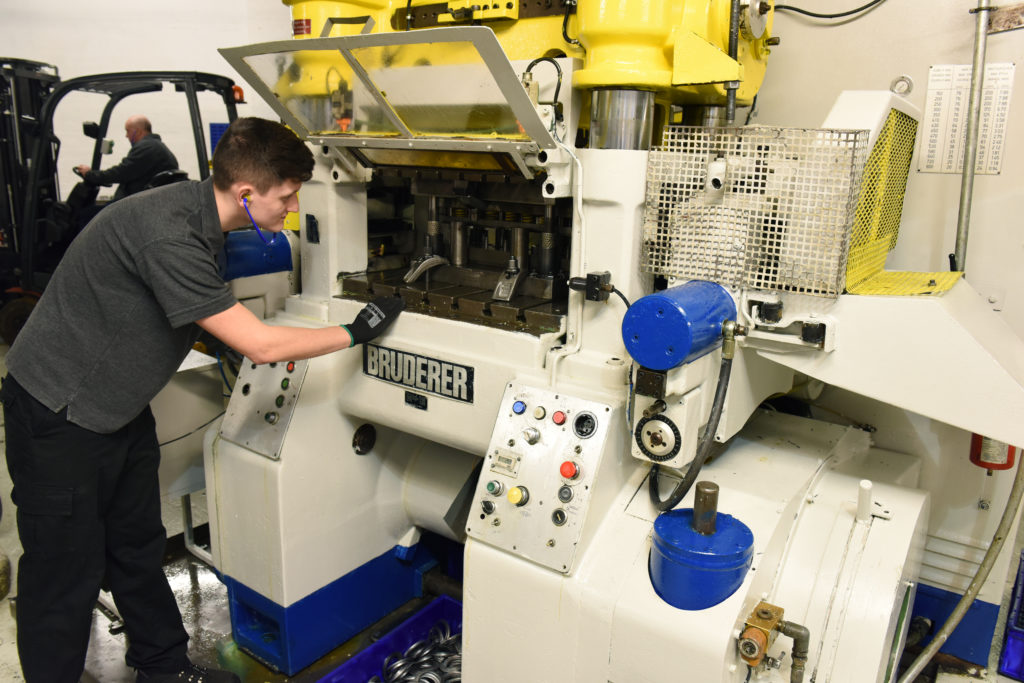
At full production speed, 700 strokes per minute leaves little room for compromise – this is the upper operating speed of the Bruderer BSTA 60-tonne progression presses at Brigham Pressings, and it provides a useful window into an area of manufacturing that often receives less attention than the finished products it ultimately supports.
Every precision metal component coming off the press is the result of a carefully engineered combination of material, tooling, feed, forming operations, lubrication, monitoring and process control. For customers, the objective is straightforward: manufacture the right component, consistently, at the volume the programme demands.
For Brigham’s engineers and toolmakers, achieving that result starts long before the press begins running. Progression pressing allows a strip of metal to move through a series of precisely engineered stations within a tool. Rather than manufacturing a component through a succession of separate processes, different operations can take place as the material progresses through the tool.
Depending on the component, these can include piercing, blanking, forming and other operations, progressively transforming flat material into the finished pressing The process can make progression tooling particularly effective for repeat and high-volume production. Brigham Pressings operates three Bruderer BSTA 60-tonne progression presses, alongside a wider press fleet ranging from 60 to 400 tonnes.
The Bruderers operate using coil-fed material and can process stainless steel, mild steel, aluminium and brass, with strip widths up to 500mm and material thicknesses up to 3mm CEO Doug Allen says the impressive production speeds only tell part of the story.
“People naturally notice the speed of a progression press, particularly when they see one operating, but the real engineering is in creating a process capable of producing the same component consistently, stroke after stroke. “That starts with understanding the component, material and volumes and then developing the tooling and manufacturing process around them.”
So why Does the Tool Matter So Much? In high-volume metal pressing, the tool is at the heart of the manufacturing process. Its design determines how material progresses through each operation and how the component is formed before it leaves the press. This is why Brigham maintains an integrated in-house toolroom alongside its production operation.
Tooling development, modification and maintenance can be supported by people working directly alongside the manufacturing teams that ultimately use those tools. That relationship becomes particularly valuable when developing a new component or transferring an existing pressing programme into Brigham.
“Tooling and presswork have to work together,” Allen explained. “Having toolmaking expertise within the business means there is a direct connection between what happens in the toolroom and what happens on the press. If we’re looking at a new programme, a transferred tool or an opportunity to improve an existing process, our teams can look at the complete manufacturing solution.”
And what does 700 Strokes Per Minute Mean for the Customer? Well speed creates production capacity, but the commercial value comes from combining that speed with repeatability and process control Brigham Pressings progression presses incorporate features including in-die sensors, process monitoring and controlled lubrication, providing information and safeguards around the production process.
For customers requiring significant annual volumes, the result can be a highly scalable manufacturing route. Once the component, material, strip layout and tooling strategy have been established, large quantities of parts can be produced through a controlled process with relatively little handling between individual manufacturing operations.
Brigham Pressings wider 60-to-400-tonne press fleet provides progression, transfer and single-operation capability, allowing its engineers to select a manufacturing route according to the component rather than attempting to fit every requirement into one process.
For Brigham Pressings, the first question isn’t simply can we press it. The engineering team considers the wider production requirement. What material is specified? What is the component geometry? What tolerances are required? What are the anticipated annual volumes? Does tooling already exist? What secondary operations will be required? How will the component be inspected and controlled?
Those questions help establish the appropriate combination of tooling, presswork, quality control and downstream processing. Brigham Pressings can support customers from tooling and prototype development through to production pressings and assemblies, alongside management of specialist processes through its established UK supply network, including plating, heat treatment and specialist finishes.
For companies considering reshoring or transferring an existing pressing, the same approach allows Brigham to examine the existing tooling and production requirements before establishing how the programme can be integrated into its manufacturing operation.
Brigham Pressings manufactures and distributes components into aerospace, defence and space, automotive, yellow goods and white goods markets, sectors where consistent production and dependable supply are central to successful programmes.
Its manufacturing operation is supported by AS9100D, IATF 16949, ISO 9001 and ISO 14001 certifications. Within aerospace particularly, AS9100D provides the framework for the traceability, quality management and process discipline expected throughout the supply chain.
But whether a component ultimately forms part of an aircraft, vehicle or industrial product, Allen believes the underlying manufacturing challenge remains remarkably similar.
“Customers ultimately need confidence in the process. “Our job is to take a component requirement and work out how we manufacture it repeatedly, efficiently and to the required standard. Sometimes that means progression pressing at significant speed. Sometimes transfer or single-operation presswork provides the better solution.
“The important part is having the presses, tooling knowledge, engineering experience and quality systems together in one manufacturing operation.” At Brigham, 800 strokes per minute may be what catches the eye. The engineering behind every one of those strokes is what makes the capability count.