
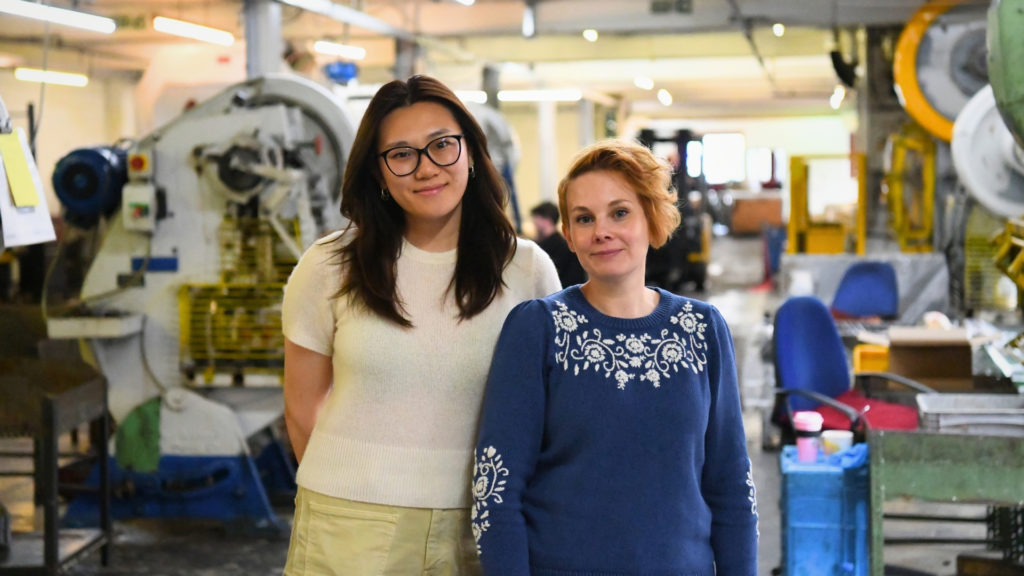
As manufacturers across Britain celebrate National Manufacturing Day on Thursday 24 September, Brigham Pressings is using the occasion to highlight the engineering, investment and ambition behind its Birmingham manufacturing operation.
Organised by Make UK, National Manufacturing Day brings together manufacturers across the country to showcase modern industry, the careers it creates and the technology and skills found inside British factories.
For Brigham Pressings CEO Doug Allen, it is also an opportunity to celebrate something much simpler: a genuine enthusiasm for making things.
“Manufacturing is what we do and we love it,” said Allen. “There is something hugely rewarding about taking a customer requirement, applying engineering knowledge to it, developing the tooling and process, and then seeing that component running successfully through production.
“Behind every pressing there are engineers, toolmakers, production teams, quality specialists and years of accumulated knowledge. National Manufacturing Day gives the industry an opportunity to celebrate those people and show just how much expertise sits inside British manufacturing businesses.”
Investing in the capability to manufacture
That commitment can be seen across Brigham’s manufacturing operation. The company operates a diverse 60-to-400-tonne press fleet, supporting progression, transfer and single-operation presswork across a range of materials, geometries and production volumes.
At the high-speed end of the operation, Brigham’s Bruderer BSTA 60-tonne progression presses are capable of running at up to 800 strokes per minute, providing the capacity required for demanding high-volume programmes.
Press capability is supported by an integrated toolroom, where tooling expertise allows Brigham to work with customers from initial development and prototype manufacture through to production tooling, maintenance and ongoing manufacturing.
Allen sees continued investment in productive capability as central to the company’s development.
“Manufacturing businesses have to keep investing in their ability to make things,” he said. “For us that means looking at our presses, tooling capability, automation, engineering resource and the skills within the business and asking where the next opportunity lies.
“Investment gives our engineers more capability to work with and gives customers greater confidence in what we can deliver. That relationship between people, equipment and engineering knowledge is incredibly important.”
Acquisition as a route to stronger UK manufacturing
Brigham is also looking beyond organic investment as it develops the next stage of the business. The company has identified acquisition opportunities as a route to expanding its manufacturing capability, adding complementary processes and preserving valuable engineering knowledge within the UK supply chain.
For Allen, acquisition has the potential to bring established skills, equipment and customer relationships together within a broader manufacturing group.
“There are some fantastic manufacturing businesses across the UK with decades of knowledge inside them,” he explained.
“We are interested in businesses where there is a strong manufacturing fit and where bringing capabilities together can create something valuable for customers. That could mean additional capacity, complementary processes, specialist knowledge or access to new markets.
“We want to grow Brigham as a manufacturer. Acquisition is one of the ways we can invest in that ambition while helping to retain important manufacturing capability here in Britain.”
Turning new ideas into production
Manufacturing also begins long before volume production. New Product Development (NPD) has become an increasingly important part of Brigham’s customer relationships, particularly where early manufacturing input can influence component design, tooling strategy and the route into production.
Design-for-manufacture expertise allows Brigham’s engineers to consider how a component will be formed, how material will behave through the process, how tooling should be designed and how repeatability can be achieved once volumes increase. That approach has recently been demonstrated through rapid tooling and product-development projects supporting demanding automotive and aerospace applications.
“We enjoy being involved early,” said Allen. “That is where manufacturing knowledge can make a real contribution to product development.
“You can look at a component and start thinking immediately about how it will be tooled, how material can be used efficiently, how operations can be simplified and how the process will work when you move into production volumes.
“NPD brings together design, engineering, tooling and manufacturing. It is one of the areas where the depth of experience within a manufacturing business really comes to the fore.”
Connecting manufacturing with research
Brigham’s approach to innovation also extends into collaboration with academia through Knowledge Transfer Partnerships (KTPs). KTPs provide a framework for businesses to work alongside universities and academic specialists, bringing research expertise into an industrial environment and applying it to commercial manufacturing challenges.
For an established presswork business, that relationship creates opportunities to explore new technologies, processes and approaches while developing knowledge that can ultimately be applied on the factory floor.
Allen believes these connections will become increasingly valuable as manufacturing technology continues to develop.
“The factory and the university can learn a great deal from each other,” he said. “Manufacturers bring practical production experience and real industrial challenges, while academic partners can bring research capability and fresh thinking.
“KTPs give us an opportunity to connect those two environments around projects with a genuine manufacturing application. That is exciting for the people involved and valuable for the longer-term development of the business.”
Quality built around demanding industries
The same manufacturing philosophy extends into quality. Brigham operates to AS9100 Rev D, alongside IATF 16949, ISO 9001 and ISO 14001, supporting customers across aerospace, defence, automotive and other demanding engineering sectors.
Within aerospace in particular, AS9100 provides the framework for the traceability, process control and quality management required throughout complex manufacturing programmes. From material certification and tooling validation through to First Article Inspection, batch traceability and final inspection, quality sits alongside presswork and engineering as part of the manufacturing process.
“Quality is part of manufacturing,” said Allen. “When you are supplying sectors such as aerospace, customers need confidence in the component, the process that produced it and the systems surrounding that process.
“AS9100 reflects the discipline that exists throughout the business. It supports our ambitions in aerospace and defence and gives customers a clear understanding of the standards we work to.”
A day to celebrate making things
National Manufacturing Day comes at an important time for British industry. Make UK estimates that manufacturing contributes around £220 billion to the UK economy and supports 2.6 million jobs, while manufacturers continue to invest in their workforces and the communities around their operations.
For Brigham Pressings, the industry’s future will be shaped inside factories: through investment in productive capacity, the development of engineers and toolmakers, closer collaboration with academia and the willingness of manufacturers to keep developing new products and processes.
It is also why Allen believes the industry should take opportunities such as National Manufacturing Day to talk more confidently about what it does.
“There is an enormous amount of skill, technology and creativity in UK manufacturing,” he concluded.
“Walk through our factory and you see presses producing precision components at speed, toolmakers solving engineering problems, quality teams working to demanding standards and engineers developing the next generation of manufacturing processes. You also see people who genuinely enjoy making things.”
“That is what National Manufacturing Day means to us. We are proud to manufacture in Birmingham, proud of the capability we continue to build here and excited about where we can take it next. “We love manufacturing.”