
Changing markets have always been part of manufacturing. What is becoming increasingly important is the ability to apply established engineering capability to new products, sectors and production requirements as investment moves across the economy.
Recent figures from the UK commercial vehicle sector for instance provide a useful example. Production of vans, HGVs, buses and coaches has softened considerably during 2026, while the Society of Motor Manufacturers and Traders has highlighted the potential for future growth around zero-emission vehicles, specialist conversion, batteries, powertrains and the wider supply chain At the same time, September’s UK Manufacturing PMI remained in expansion territory at 51.9, with investment goods providing some of the strongest growth.
For Birmingham manufacturer Brigham Pressings, the combination illustrates why versatility is becoming such a valuable industrial asset.
The company has its roots in automotive manufacturing, yet the engineering expertise behind a precision metal pressing rarely belongs exclusively to one market. Brigham now applies its presswork, progression tooling, toolmaking, design-for-manufacture and assembly capabilities across automotive, commercial vehicles, aerospace, defence and other advanced manufacturing applications.
CEO Doug Allen believes that breadth creates opportunities as individual markets move through different investment cycles.
“Manufacturing demand is constantly evolving,” said Allen. “The skills we have developed through automotive production are highly transferable. The challenge for a business like ours is to keep investing in those skills and demonstrate how they can solve manufacturing problems across a much wider range of industries “A component might ultimately be used in a vehicle, an aircraft, an electrical system or another engineered product. From our perspective, the fundamental questions are often very similar: can we design an efficient manufacturing process, develop the tooling, achieve the required quality and produce it consistently at the volume the customer needs?”
That transferability is becoming increasingly relevant across British industry, because commercial vehicles are moving towards new powertrain architectures. Aerospace manufacturers are increasing production rates. Defence spending is creating opportunities for companies with established manufacturing capacity, while investment in energy infrastructure is generating requirements for components across electrical and mechanical systems.
These markets have their own standards and technical requirements, yet they draw on many of the same underlying manufacturing disciplines. For Brigham, that starts with the component itself.
Its engineers can work with customers during product development to assess how a part might be manufactured more efficiently through pressing. Geometry, material selection, tolerances, production volumes and the number of operations required can all influence the eventual tooling and production strategy.
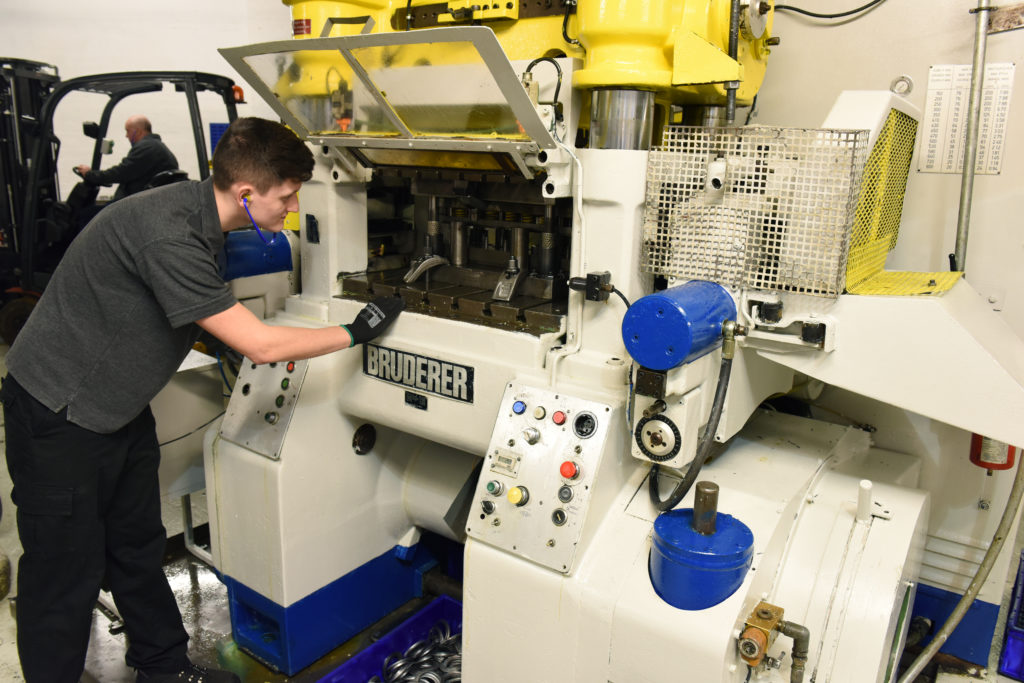
Once that route has been established, Brigham’s in-house toolmaking capability allows the business to develop the tooling required for production before moving components into serial manufacture. At the high-volume end of its capability, the company’s Bruderer progression presses can operate at speeds of up to 800 strokes per minute, creating the capacity for substantial production runs where the application demands it.
Elsewhere, different presses, tooling strategies and secondary operations allow Brigham to address lower-volume or more complex requirements.
Allen sees that range as increasingly important.
“Versatility is partly about having different equipment, but it is also about how you use it,” he said. “We have experience of high-volume automotive production, complex tooling and demanding quality requirements. We can take that knowledge and apply it to a customer entering production in another sector. “That is particularly useful when somebody has designed a product and needs to establish how it can be manufactured economically at scale.”
The current industrial picture also places greater emphasis on the engineering that surrounds production. September’s PMI survey reported rising costs for energy, electronics and transport, together with longer supplier delivery times. Against that background, productivity, material utilisation and reliable production become increasingly valuable.
Presswork can offer significant advantages where a component and its anticipated volumes lend themselves to the process. A progression tool can incorporate several operations within a continuous manufacturing sequence. Once developed and proven, the process can produce components rapidly and repeatedly, with automation reducing handling between individual stages.
The economics are particularly compelling when production runs move into hundreds of thousands or millions of components.
“The conversation we want to have with customers is about the manufacturing process as a whole,” Allen explained. “Sometimes there is an opportunity to simplify a component, improve material utilisation or design several operations into the tooling. “That is where experience becomes valuable. The press is one part of the equation. The engineering decisions made before production starts can influence cost, quality and output throughout the life of the programme.”
Brigham’s automotive heritage remains an important part of that proposition. Supplying a sector built around volume, repeatability, scheduled production and tightly controlled component quality has shaped the company’s manufacturing approach. Increasingly, those disciplines are being applied elsewhere.
The business has expanded its presence in aerospace and defence and secured AS9100 certification, providing a quality framework recognised throughout the aerospace supply chain. It has also pursued new product development and Knowledge Transfer Partnership activity as it looks at how established manufacturing techniques can be applied to emerging requirements. Rather than treating diversification as a move from one industry into another, Allen sees it as an extension of the company’s engineering base.
“We have invested in capabilities that have relevance across several markets,” he said. “Automotive remains an important sector for us, and the experience gained there strengthens what we can offer elsewhere.
“When we talk to customers in aerospace, defence or other advanced manufacturing sectors, we bring decades of experience in making components repeatedly, efficiently and to controlled standards. We then adapt that knowledge around the particular requirements of their programme.”
That ability could become increasingly important as Britain seeks to capture more value from investment in transport, defence, aerospace and energy. New factories and major programmes attract attention, but their economic reach depends considerably on the supply chains that form around them.
Established manufacturers already possess presses, machine tools, production engineers, toolmakers, quality systems and decades of practical manufacturing knowledge. Connecting those capabilities with emerging programmes offers a route to expand domestic supply without having to create every element of manufacturing capacity from scratch.
The transition towards electric vans, buses and HGVs will change many of the components required within a vehicle, while continuing to create demand for brackets, retainers, electrical components, structural pressings and numerous other manufactured parts. Specialist and low-volume vehicle programmes add another layer of potential demand. Similar opportunities are emerging as aerospace production increases and defence manufacturers look deeper into the UK supply chain for capacity and expertise.
Allen believes manufacturers themselves have a role to play in making those connections.
“UK industry has a huge amount of capability already sitting within its supply chain,” he said. “Our job is to keep developing that capability and make sure customers understand what it can do. “For Brigham, versatility gives us the opportunity to support established automotive programmes while building relationships in commercial vehicles, aerospace, defence and other growth markets. They may be very different industries, but good manufacturing engineering travels remarkably well.”
For a company whose presses have spent decades producing components at industrial scale, that adaptability may prove every bit as important as production speed.