
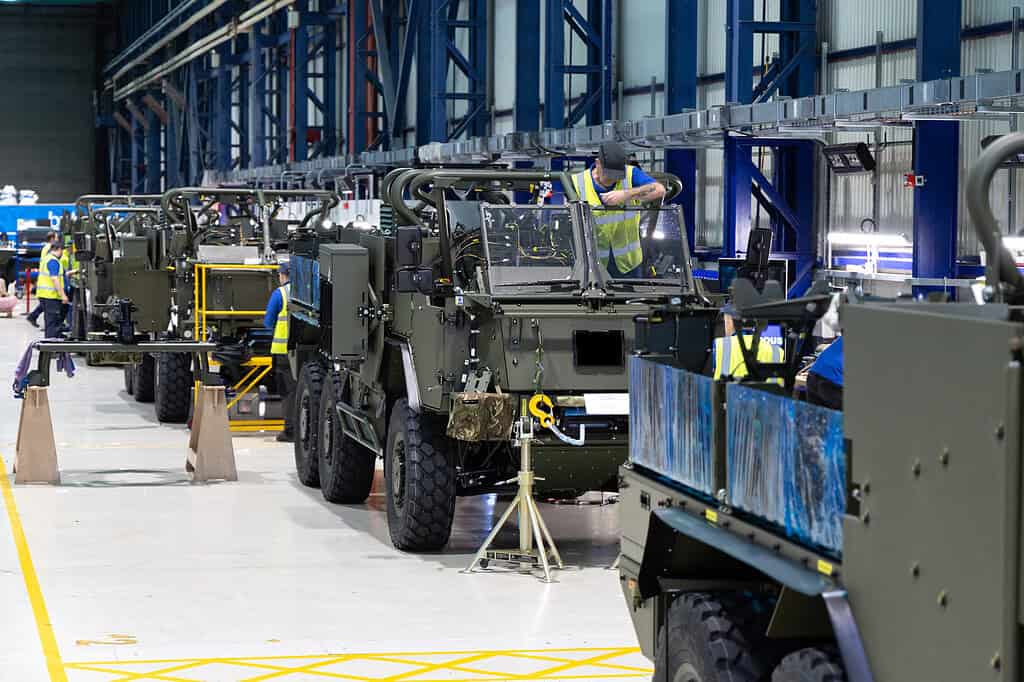
Photo Source: Babcock
Britain’s defence manufacturing footprint is expanding at a pace that creates opportunities well beyond the companies whose names appear on aircraft, vehicles, ships and weapons systems. New research shows the UK has attracted 34 defence manufacturing investments since the beginning of 2024, the largest national share of the 197 projects identified across Europe. Investment is flowing into munitions, aircraft, naval programmes, drones and autonomous systems, bringing new factories and production capacity with it.
For established UK manufacturers such as Birmingham-based Brigham Pressings, the significance lies further into the supply chain. Every additional production line creates demand for manufactured components, tooling, assemblies and engineering capacity. As programmes move from development towards sustained production, suppliers capable of producing repeatable, high-quality components at industrial volumes become part of the equation.
Brigham Pressings CEO Doug Allen believes the current investment cycle presents an opportunity for Britain’s existing manufacturing base to play a greater role in defence.
“Major defence programmes ultimately depend on a very broad manufacturing supply chain,” said Allen. “Behind the final platform are thousands of components and a huge amount of engineering, tooling, production and quality expertise. “The UK already has manufacturers with that capability. As investment increases, there is a real opportunity to connect those businesses with defence programmes and build more of the associated manufacturing value here.”
The figures underline the scale of the industrial activity taking place. According to research reported by ADS Advance, the UK accounted for 17% of European defence manufacturing facility investments announced or opened between January 2024 and August 2026, ahead of Germany and France.
The nature of those projects is equally significant because ten of the 21 European investments identified in drone and autonomous vehicle production are located in the UK, alongside eight investments associated with aircraft and naval manufacturing. Expansion is also taking place across weapons, munitions and specialist production facilities.
For the wider manufacturing sector, each represents the beginning of a much longer industrial chain. Aircraft need brackets, clips, retainers, housings and structural components. Military vehicles require pressed and fabricated parts throughout their structures and systems. Electronics, communications equipment, autonomous platforms and power systems introduce their own requirements for precision metal components and assemblies.
Some will be produced in relatively modest quantities. Others will move into sustained production programmes where repeatability, productivity and security of supply become increasingly important. This is where Brigham sees a natural fit for manufacturing expertise developed across demanding industries.
The company provides precision metal pressings, progression presswork, stampings, tooling and assemblies, backed by an in-house toolroom and design-for-manufacture capability. Its production equipment ranges from conventional pressing capacity through to high-speed Bruderer progression presses capable of operating at up to 800 strokes per minute.
“The opportunity is broader than simply having spare production capacity,” Allen explained. “A customer may come to us with a component that needs to move from a design into an efficient production process. That brings in material choice, tolerances, tooling, the number of forming operations, inspection and ultimately the volumes required.
“Our role is to understand how that component can be manufactured reliably and then engineer the process around it.”
The West Midlands has a particular stake in this expansion because its automotive heritage has created a dense concentration of manufacturers experienced in tooling, presswork, machining, fabrication, assembly and volume production. Many of those capabilities have direct applications within defence.
Brigham is one example of how that expertise is travelling. Automotive manufacturing has given the company extensive experience of repeatable production, complex tooling and programmes requiring large quantities of components manufactured to controlled specifications. Brigham has subsequently broadened its work across aerospace and defence, supported by AS9100 certification.
Allen sees the combination as valuable as defence manufacturers increase output.
“There is a considerable amount of transferable knowledge within the UK automotive supply chain,” he said. “Toolmakers understand how to turn a component design into something that can be produced efficiently. Presswork businesses understand repeatability and volume. Quality teams understand traceability and process control. “These are valuable manufacturing disciplines in defence as programmes move into production.”
The crossover also works in the other direction. Requirements associated with aerospace and defence bring further emphasis to documentation, traceability, inspection and controlled manufacturing processes, strengthening capabilities that can subsequently be applied across the business.
For Brigham, one of the most valuable opportunities comes before serial production begins. Involving manufacturing engineers while a component is being developed can allow its design and production process to evolve together.
A part initially envisaged as several pieces, for example, may lend itself to a different pressed solution. Geometry can sometimes be refined around tooling requirements. Material utilisation can be considered alongside component performance, while the anticipated production volume helps determine the most appropriate tooling strategy.
At scale, these decisions influence the economics of a programme for years. “Design for manufacture is a major part of what we bring to a project,” said Allen. “The earlier you can consider production, the more opportunity there is to engineer an effective solution.
“Once a programme reaches volume production, relatively small improvements in cycle time, material usage or the number of operations can become significant. Good tooling captures those decisions and repeats them every time the press cycles.”
That experience has also been demonstrated in Brigham’s work outside its traditional automotive base, including projects requiring rapid tooling development and high-volume production solutions for components destined for demanding aerospace and automotive environments.
The investment taking place across defence also raises an important question around scale. New factories provide additional final production capacity, while their output depends upon suppliers being able to grow alongside them A production line manufacturing more vehicles, aircraft, autonomous systems or weapons requires a corresponding increase in component supply. Manufacturers therefore need confidence that suppliers can maintain quality as volumes increase and sustain production over lengthy programme cycles.
For presswork, tooling provides one route to achieving that scale – progression tools can combine multiple forming operations within a continuous process, allowing components to be produced rapidly once the tooling has been developed and proven. Automated material feeds and high-speed presses can then support substantial volumes with controlled repeatability.
Brigham’s wider capability allows the production approach to be matched to the requirement rather than a single type of work. That flexibility matters in defence, where programmes can range from specialist equipment produced in relatively small numbers to components required in much greater quantities.
“Defence is a broad market,” Allen said. “There are applications where production volumes are relatively specialised and others where the requirement can become substantial.
“A versatile manufacturing base gives us the ability to look at the component, its complexity and its forecast demand, and develop the production route accordingly.”
The scale of planned defence expenditure suggests this industrial expansion has further to run. Investment in major facilities will naturally remain highly visible. Its wider economic effect will be determined partly by how deeply programmes connect with manufacturers across Britain.
That includes businesses with decades of production experience whose factories were originally built around automotive and general engineering requirements, alongside specialist aerospace and defence suppliers. For Brigham, the opportunity is to bring those worlds closer together.
The company continues to invest in its manufacturing capability while developing new products and processes through engineering and Knowledge Transfer Partnership activity. Its diversification provides access to several markets while retaining the production disciplines built through high-volume manufacturing. Allen believes this existing industrial infrastructure should form an important part of Britain’s defence manufacturing expansion.
“Building sovereign manufacturing capability is also about making effective use of the engineering base we already have,” he said.
“Across the UK there are experienced people, established factories, toolrooms, presses and production equipment capable of supporting this growth. The opportunity is to bring that capacity into the defence supply chain, invest where programmes require it and build long-term manufacturing relationships.”
The latest investment figures show that defence production is increasingly being located in Britain. For the thousands of manufacturers capable of supplying the components, tooling and engineering behind those programmes, the next stage is turning that investment into production on factory floors throughout the UK.