
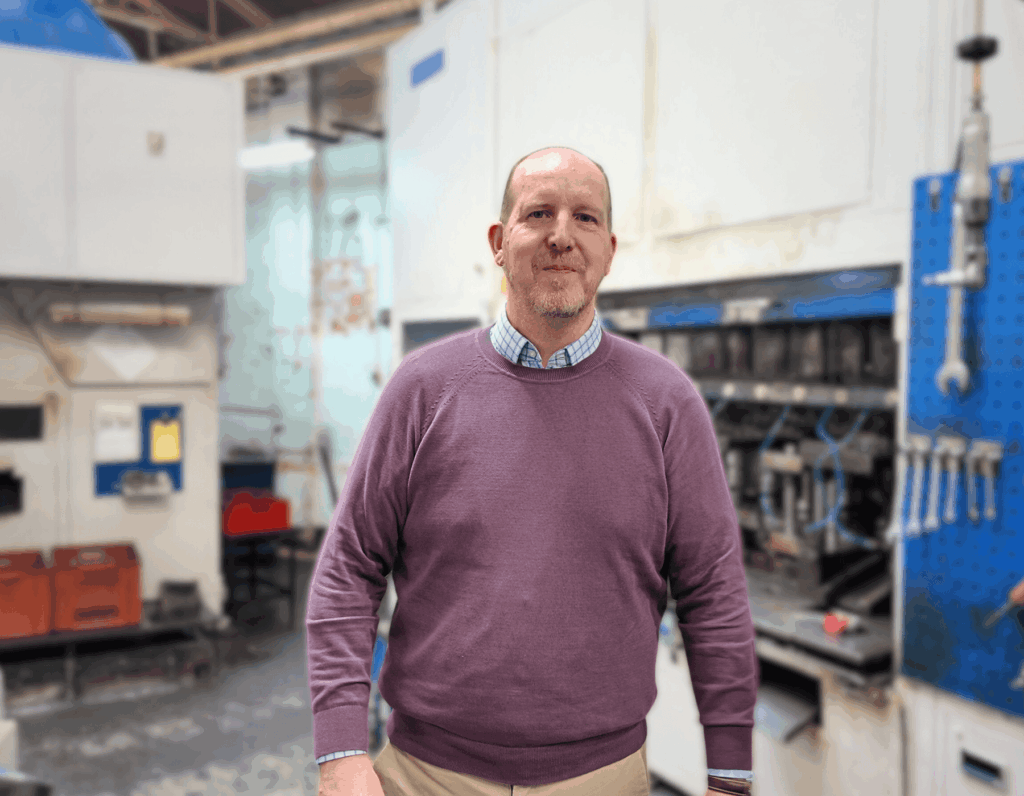
HT Brigham’s story begins like many Midlands manufacturers: one machine, one small workshop, and a handful of people prepared to work all hours. What’s different is how the business has evolved.
“The company has changed out of all recognition in terms of technology, data and markets,” says CEO Doug Allen. “The core idea is the same as it was in 1947 – make critical parts that customers don’t have to think about. They just work, every time.”
The firm specialises in progression presswork, complex multi-stage transfer pressings and assemblies, supplying components in volumes that range from tens of thousands to many millions. Customers span Tier 1 automotive suppliers, industrial OEMs and increasingly aerospace partners.
What HT Brigham sells, says Allen, is reliability.
“We sit in that space where you have to get it right first time, every time,” he explains. “Our customers build production lines around our parts. If we slip, they stop. That clarity of responsibility drives everything – from the way we invest in presses to how we develop our people.”
Innovation on the press line
Recent investment has focused on deepening that reliability while creating headroom for growth. A flagship example is the strategic refurbishment of a 250-ton Rhodes progression press – effectively giving a proven workhorse a new lease of life.
“The Rhodes press is a classic piece of British engineering,” says Allen. “New controls, new guarding, new monitoring. We’ve taken an asset that operators trust and aligned it with modern expectations on uptime, data and safety.”
For Allen, this is business logic.
“Our philosophy is to combine the best of what we have with the best of what’s new,” he says. “You don’t throw away capability that works; you enhance it. That’s how you create resilience in a factory – with robust equipment, strong processes and people who understand both.”
That thinking is codified in the Brigham Operating System (BOS), the company’s internal framework for continuous improvement. BOS ties together maintenance, quality, training and performance measurement into what Allen calls “a single language for how we run the place”.
“At the core of BOS is a simple belief,” he explains. “If our people are set up to succeed – with the right tools, clear standards and a safe, supportive environment – the performance follows. People first, then process, then profit. In that order.”
Aerospace ambitions take flight
HT Brigham’s renewed AS9100 certification is the clearest signal yet of where the company is heading. The aerospace-quality accreditation, held alongside ISO 9001, ISO 14001 and IATF 16949, effectively opens the door to more complex, mission-critical work.
Allen’s own CV – spanning senior roles at Moog, UTC Aerospace Systems and Goodrich – has helped shape that trajectory.
“In aerospace, quality and compliance aren’t initiatives – they’re the ticket to the game,” he says. “AS9100 forces a level of discipline that we welcome. It means our processes, traceability and mindset are aligned with the expectations of primes and Tier 1s.”
He’s clear this is not a rebadging exercise.
“Renewing AS9100 isn’t about proving we can deliver aerospace-grade quality with the responsiveness and agility of a mid-sized presswork specialist. That’s a value proposition customers remember.”
The refurbished Rhodes press plays a key role here, boosting high-volume capacity while maintaining the tight tolerances aerospace components demand.
Nurturing the next generation
If machinery and accreditations are the visible signs of change, HT Brigham’s people strategy is the part Allen talks about most.
A cornerstone of that approach is a Knowledge Transfer Partnership (KTP) with Birmingham City University, focused on new product development and embedding innovation into the company’s culture.
“Partnerships like the one with Birmingham City University are vital,” says Allen. “They bring new thinking into our business – from materials innovation to digital product design – while giving young engineers hands-on experience in a live manufacturing environment. It’s exactly the kind of collaboration that keeps UK industry evolving.”
The KTP is already feeding into projects that cut across engineering, marketing and business model innovation, including work through sister business Brigham Watch Company to better understand end-customer expectations in premium consumer markets.
For Allen, the goal is broader than any single project.
“We’re trying to build an environment where apprentices, graduates and experienced engineers can all see a future,” he says. “Whether you’re passionate about CAD, tooling design, data analysis or sustainability, there should be a pathway here. That’s how we keep the talent pipeline flowing – by making manufacturing a compelling career, not just a job.”
Quality, community and continuity
Despite the push into new sectors, HT Brigham still trades heavily on the values that defined its early years as a family business: professionalism, accessibility and a strong sense of community.
“Customers come because when there’s a problem, they can pick up the phone and speak to someone who understands their product, their line, their pressures. We’re big enough to handle complex programmes, but small enough to care about the detail.”
That ethos runs through the wider Brigham Group, where the language is more about partnership and problem-solving than units and margins.
“If a customer is struggling with a forming challenge, we get in the room, sketch ideas, look at tooling options, understand the lifetime cost. The best relationships are the ones where we’re part of the engineering conversation, not just a name on a purchase order.”
Looking ahead: investing to stay ahead
As UK manufacturers navigate skills shortages, cost pressures and shifting global supply chains, Allen is blunt about what will separate those who thrive from those who struggle.
“Innovate and invest in internal capability,” he says. “That’s the only way I see long-term survival. We can’t wait for policy or rely on someone else’s technology roadmap. We have to take control of our own.”
For HT Brigham, that means three parallel tracks:
Investing in equipment and data – from upgraded presses to better process monitoring.
Deepening quality and sector credentials – particularly in aerospace and other regulated industries.
Growing people and partnerships – via apprenticeships, KTPs and closer collaboration with customers and universities.
“Ultimately, we want to be the presswork partner people think of when the job really matters,” Allen concludes. “High-volume, high-integrity, no drama. If we can keep delivering that – with a smile on our faces and opportunities for our people – then we’re doing our job for British manufacturing.”
In Coleshill, the presses keep running; the parts keep shipping; the next generation of engineers is beginning to find its footing. HT Brigham might not make headlines like the brands its components serve, but in the quiet logic of supply chains, it’s exactly the kind of company that keeps modern industry moving.