
Growing disruption across the UK steel supply chain is creating fresh challenges for manufacturers — but for businesses willing to adapt, invest and strengthen capability, it may also accelerate a wider shift towards more resilient and higher-value British manufacturing.
Recent warnings from the Confederation of British Metalforming (CBM) have highlighted mounting concerns around steel quotas, tariffs and material availability, with downstream manufacturers increasingly facing supply uncertainty, rising costs and delivery delays.
Yet while much of the debate has focused on Government policy, Birmingham-based HT Brigham Pressings believes the situation also underlines why UK manufacturers must continue investing in domestic capability, engineering agility and supply chain resilience.
Doug Allen, CEO of HT Brigham Pressings, says the sector cannot simply wait for external conditions to improve.
“The reality is that UK manufacturers have to control what they can control,” said Allen.
“We cannot build resilient businesses purely around the assumption of stable global supply chains or predictable international trade conditions anymore. Manufacturers need agility, strong supplier relationships and the ability to respond quickly when markets shift.”
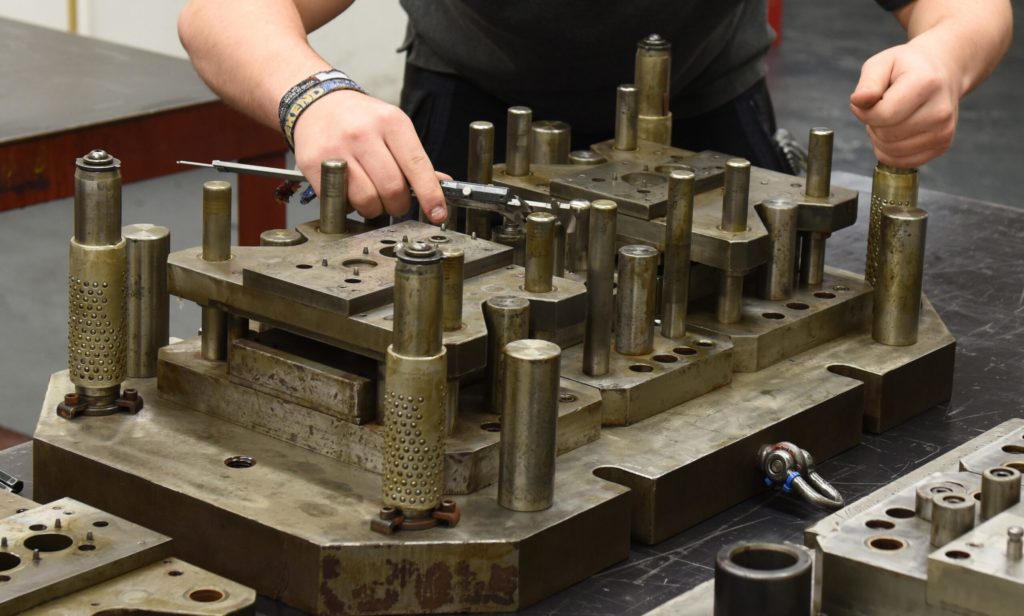
For HT Brigham Pressings, that strategy has centred on maintaining broad in-house manufacturing capability, investment in tooling expertise and the flexibility to support complex, lower-to-medium volume production programmes where responsiveness matters as much as cost.
Operating a diverse press fleet from 60 to 400 tonnes, the company manufactures precision metal pressings, stampings and presswork for sectors including aerospace, automotive, defence and industrial engineering.
Allen believes those capabilities are becoming increasingly important as OEMs look to de-risk supply chains and reduce exposure to overseas uncertainty.
“What customers are increasingly looking for is not simply a component supplier, but a dependable manufacturing partner,” he explained.
“They want confidence around quality, communication, lead times, engineering support and programme management.”
“That is where agile UK manufacturers can create real value.”
The company’s integrated toolmaking capability also allows HT Brigham to react quickly to changing customer requirements, production adjustments and new project introductions without relying entirely on external tooling support.
“In-house toolmaking gives manufacturers greater control and responsiveness,” Allen said.
“When supply chains tighten or programmes change, having those engineering and tooling capabilities internally can make a significant difference to delivery performance and customer confidence.”
The pressures facing the wider steel market are also accelerating demand for suppliers capable of delivering high-quality, technically demanding components closer to the point of final assembly.
For aerospace and defence customers in particular, quality assurance and traceability remain critical considerations.
HT Brigham Pressings operates to AS9100 standards, supporting customers that require stringent quality management, process control and regulatory compliance across complex manufacturing programmes.
Allen says accreditation and engineering discipline increasingly separate serious manufacturing partners from commodity suppliers.
“In sectors like aerospace and defence, customers are not purely buying capacity — they are buying assurance,” he said.
“They need suppliers that understand documentation, traceability, consistency and the importance of maintaining rigorous quality systems throughout production.”
“That is where UK engineering businesses with the right accreditations, skilled workforce and manufacturing culture can compete extremely well internationally.”
While steel supply pressures continue to create uncertainty across industry, Allen believes the situation may ultimately accelerate a broader shift already underway within UK manufacturing — away from low-margin commodity production and towards capability-led engineering.
“The UK will not compete globally by chasing the cheapest production,” he added.
“But we can compete exceptionally well on engineering quality, technical expertise, responsiveness and complex manufacturing capability.”
“The manufacturers that continue investing in skills, tooling, automation and quality systems will be the businesses best positioned for the future.”
As OEMs increasingly reassess supply chain resilience, businesses capable of combining precision presswork, engineering agility and accredited manufacturing standards may find themselves playing a more strategic role in the next generation of British industry.